





Historic Environment Policy and Practice Vol 15, No 3 2024
The latest issue of Historic Environment Policy and Practice (Vol 15, No 3 2024) notes that many of the papers submitted to the journal aim to understand the context in which heritage professionals work: the relationship between policy and practice. The emphasis of the current papers is very much on assessing where theory lends a hand in better practice.
The opening paper in the current issue begins with the observation that in India the procurement of work through traditional methods of tendering and contracting has typically resulted in poor project performance. To understand how this situation has emerged, the four authors describe the heritage conservation sector and analyse project management contracts. They argue that an awareness of institutional practice is essential in dealing with the level of uncertainty in Indian conservation. This has obvious implications elsewhere.
Another paper explores post-conflict religious heritage protection, examining the relationship between policy and practice, using the example of the conservation of churches in northern Cyprus. This is achieved through an approach inspired by what is known as actor-network theory, assessing those responsible for protecting religious heritage sites abandoned by displaced communities. Analysis and empirical data from exhaustive fieldwork has categorised how sites have been used and their state of preservation. This has revealed multiple networks of users and activities, and which networks are active, in a complex situation where the island is divided among Greeks and Turks.
A further paper looks at the destruction and disappearance of villages caused by mass migration and rapid urbanisation that has led to the depopulation and abandonment of rural settlements in China. The government response has been to create multiple officially recognised typologies to restore, protect and showcase traditional villages. By examining the implementation process of this ‘village conservation project’, the study reveals the motivations and impacts of their efforts in listing villages for conservation and development. It provides an introduction to understanding conservation practices in rural China.
The geopolitical range and the subject matter of the papers illustrates that if there are changes to the practice of historic environment management, these may be found in a deeper understanding of practice itself. Moreover, the theories of practice which have emerged in the papers shows that the interest lies not only in academic institutions but also among those working in practical implementation.
This article originally in the Institute of Historic Building Conservation’s (IHBC’s) Context 183, published in March 2025. It was written by Bob Kindred MBE.
--Institute of Historic Building Conservation
Related articles on Designing Buildings Conservation.
IHBC NewsBlog
IHBC sponsors Gardens Trust event 23-4 Sept 2026
.jpeg)
'Learning from the Past, Shaping the Future’ takes place in Milton Keynes
Renovations to Frank Lloyd Wright's Fallingwater complete
.jpg)
World Heritage Preserved project opens house for tours again
Shakespeare Birthplace Trust places Hall's Croft on HAR Register
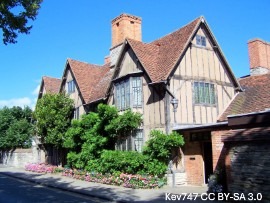
Stratford-upon-Avon home of Shakespeare's daughter is 'At Risk'
Lady Grange’s House repaired on St Kilda
.jpg)
National Trust for Scotland repairs stone cleit with link to famous island resident
Griff Rhys Jones on BBC Radio 4 Today programme
,_Green_Lane,_Derby.jpg)
The Victorian Society’s President unveiled its latest Top Ten Endangered Buildings 2026.
Need a MATE? Book your place now.

IHBC offers free webinars on applying for IHBC accreditation (Full & Associate).
UK Stained Glass Repository finds windows new homes

How are stained glass windows are rescued, stored and repurposed?
APPGEBE report sets high aims for quality
'Government must not sacrifice quality in drive to build 1.5m homes'
New measures protect Historic Shipwrecks from heritage crime

Underwater cultural heritage benefits from new HE guidance
How could the City of London skyline look in 6 years' time?

Visualisation shows approved planning applications as completed buildings
National Trust for Scotland calls for VAT cuts

Heritage neglect is encouraged by current policies
IHBC's 'Context' Issue 186 features Industrial Heritage
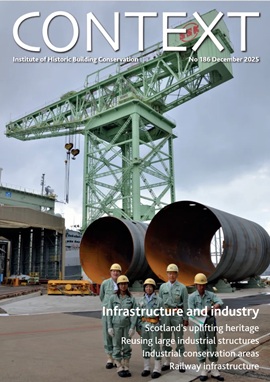
IHBC's members' journal reports on the challenges of conserving infrastructure
Book now for IHBC Annual School 2026
IHBC Annual School is taking place 18-20 June 2026 in Newcastle
RICHeS Research Infrastructure offers ‘Full Access Fund Call’

RICHeS offers a ‘Help’ webinar on 11 March
Latest IHBC Issue of Context features Roofing
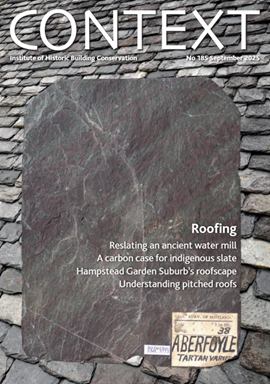
Articles range from slate to pitched roofs, and carbon impact to solar generation to roofscapes
Three reasons not to demolish Edinburgh’s Argyle House

Should 'Edinburgh's ugliest building' be saved?
IHBC’s 2025 Parliamentary Briefing...from Crafts in Crisis to Rubbish Retrofit
IHBC launches research-led ‘5 Commitments to Help Heritage Skills in Conservation’
How RDSAP 10.2 impacts EPC assessments in traditional buildings

Energy performance certificates (EPCs) tell us how energy efficient our buildings are, but the way these certificates are generated has changed.